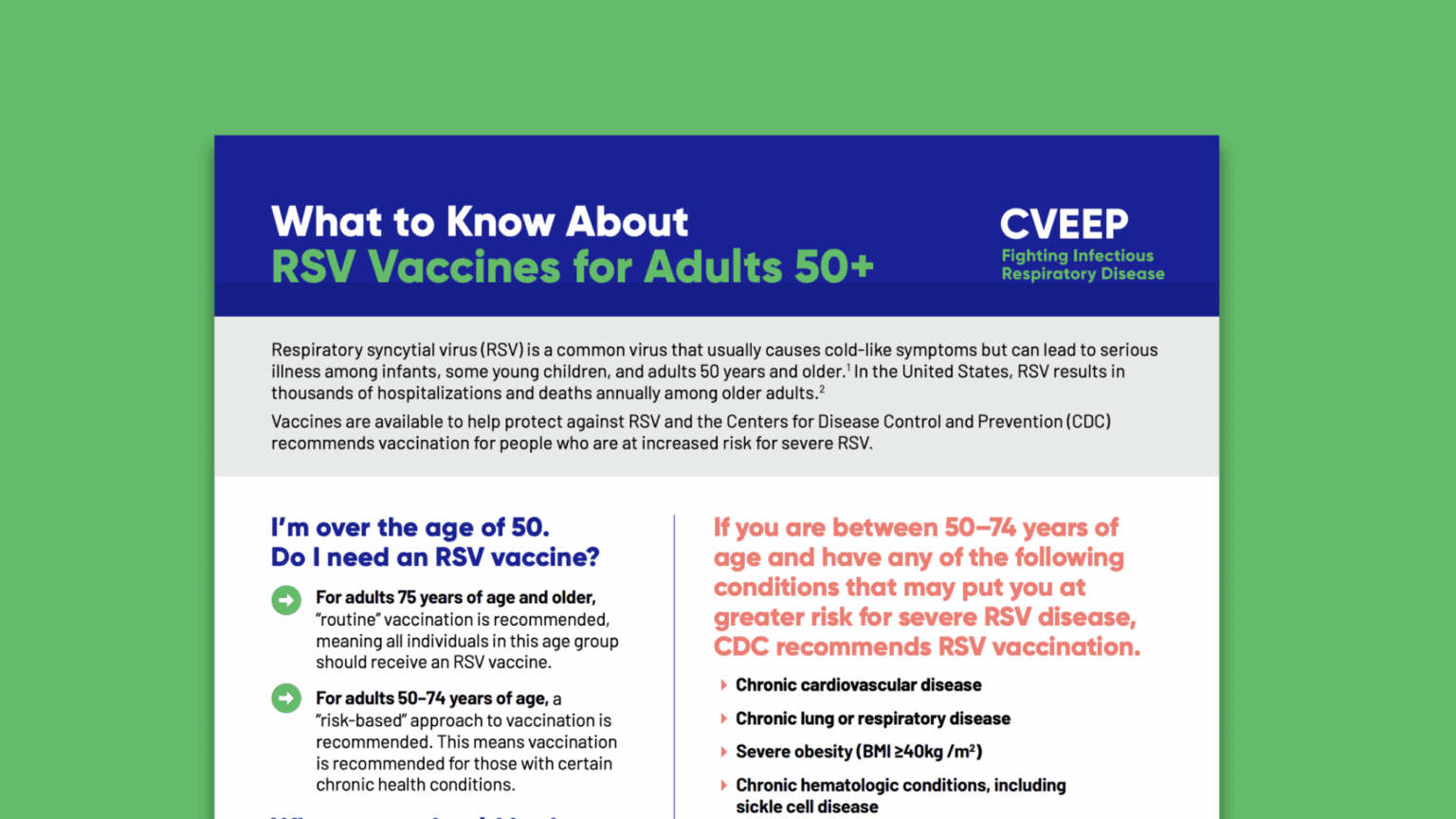
Risk-based vaccine recommendations are an important mechanism by which public health authorities provide guidance, encourage vaccination, and reach vulnerable populations. That said, implementation of risk-based recommendations can prove challenging.
As we navigate this year’s respiratory illness season, Champions for Vaccine Education, Equity and Progress (CVEEP) held a discussion focused on best practices to support equitable access to respiratory vaccines, which will include an overview of CDC’s Advisory Committee on Immunization Practices (ACIP) recommendations for respiratory vaccines, and considerations specific to risk-based recommendations. Featuring insights from leading public health experts, clinicians, and government officials, the event explored what is working, where there might be barriers to implementation and gaps in communication and, how the public health community can work together to ensure all individuals are able to receive the vaccines they need.
Panelists included:
The discussion was moderated by Amy Pisani, CEO of Vaccinate Your Family.
For pregnant people, maternal vaccines are critical to prenatal care and help protect infants during their first few months of life when newborns are vulnerable to infectious respiratory diseases. As we approach the 2024-2025 respiratory illness season, four vaccines are available to help protect infants, including newly available prevention options. Yet, despite the important role of vaccines during pregnancy, rates of maternal vaccine uptake remain suboptimal.
To further this discussion, Champions for Vaccine Education, Equity and Progress (CVEEP) hosted a conversation on current maternal vaccine guidance, including the maternal RSV vaccine, and potential solutions to address barriers that can impact access to recommended vaccines. The discussion featured provider perspectives across the healthcare continuum and addressed what individuals and organizations can do to help promote maternal vaccination.
Panelists included:

Ensuring that all individuals have access to recommended vaccines — the most effective way to protect both children and adults from many serious and potentially deadly diseases — is a public health priority. Several federal programs exist to advance vaccine access and equity. For more than 30 years, the Vaccines for Children (VFC) Program, a federally funded program, has provided all ACIP-recommended vaccines free of cost to children who may not otherwise be able to be vaccinated due to inability pay. Furthermore, in response to COVID-19 vaccines’ transition to the commercial market, CDC and HHS established the Bridge Access Program, which provides free COVID-19 vaccines for the 25-30 million adults who do not have health insurance or whose health insurance does not cover all COVID-19 vaccine costs.
However, as the Bridge Access Program is set to expire at the end of 2024, the U.S. may soon face a major gap in vaccine equity as uninsured adults will be without a federal program that ensures their access to free vaccines. Given the success of the VFC program, public health advocates have called for a Vaccines for Adults or Vaccines for All program that would ensure that both children and adults—regardless of their insurance status—have access to all recommended vaccines.
To further this ongoing conversation, the COVID-19 Vaccine Education and Equity Project hosted an online event aimed at examining the need for a federal vaccine program such as Vaccines for Adults or Vaccines for All. Panelists discussed the low rates of recommended adult immunizations and the need for a federal program that ensures adults’ access to vaccines, the success of the VFC program as a model, and the potential impacts of the creation of such a program.
Panelists included:
“Today’s actions are an essential step in helping protect public health in advance of the fall and winter respiratory illness season. The broad-based routine and FDA-authorized and approved recommendations endorsed today enable anyone who could benefit from the vaccine to get immunized, if they choose,” said Sue Peschin, President and CEO of the Alliance for Aging Research, one of three conveners of the COVID-19 Vaccine Education and Equity Project.
“Medicare, Medicaid, and private insurers are required by law to cover, with no cost sharing, updated COVID-19 vaccines. For the uninsured, the Administration is deploying the Bridge Access program to provide no-cost access to COVID-19 vaccines for adults through public health clinics, community health centers, and participating retail pharmacies. And children, regardless of insurance status, have access to no cost vaccines through the Vaccines for Children program,” said Beth Battaglino, RN-C, CEO of Healthy Women, one of three conveners of the COVID-19 Vaccine Education and Equity Project.
“Because of recent changes to the law, access to vaccines is better than at any previous time, but access doesn’t always translate into action. We need to continue to spread the word that vaccination is one of the most effective things we can for ourselves individually as well as for the public health,” said Karyne Jones, President and CEO of the National Caucus and Center on Black Aging, one of three conveners of the COVID-19 Vaccine Education and Equity Project.
The COVID-19 Vaccine Education and Equity Project recently launched the You’re Covered campaign, a multi-stakeholder effort to provide the latest information on how COVID-19 vaccines are covered by private and public insurance – and to offer details on how, in almost all cases, updated vaccines remain available at no cost to the public. For resources in English and Spanish, visit covidvaccineproject.org/covered.
###
As more than 255 leading organizations representing patients, caregivers and families, diverse communities, healthcare workers, older Americans, veterans, frontline workers and scientists, the COVID-19 Vaccine Education and Equity Project launched in December 2020 to provide information about the clinical trials process, regulatory review, distribution of and access to COVID-19 vaccines in a way that promotes equity and trust. Support for the project has been provided by Pfizer, Inc., Johnson & Johnson’s Janssen and Novartis. Learn more at covidvaccineproject.org and follow us on Facebook, Instagram, LinkedIn, TikTok, and X at @COVIDVxProject.