Vaccines: Cost & Coverage
Need vaccine information?
Check out the resources below.
Visit
Visit
Infectious diseases are a threat to public health. Vaccines to help prevent them are covered at no cost for most people.
Vaccines are the best way to protect against illness, especially severe illness, from infectious diseases. Nearly all private and public health insurance plans cover all vaccines recommended by the Centers for Disease Control and Prevention’s (CDC’s) Advisory Committee on Immunization Practices (ACIP) free of cost.
How are vaccines covered by insurance?
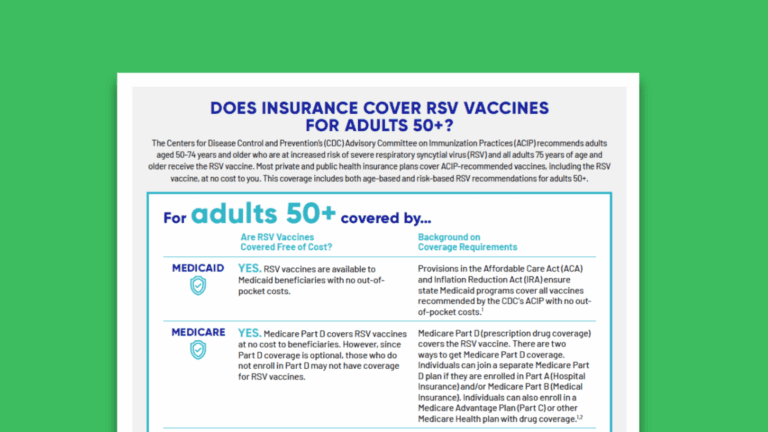
Adults Insurance Coverage of Vaccines
| Insurance Type | Are Respiratory Vaccines Covered Free of Cost? |
|---|---|
MEDICAID |
YES. All ACIP-recommended vaccines are available to Medicaid beneficiaries with no out-of-pocket costs. |
MEDICARE |
YES. Under Medicare, all ACIP-recommended vaccines are covered through either Medicare Part B or Part D without cost-sharing. Medicare Part B vaccines include those for flu, COVID-19, and pneumococcal disease. Vaccines for RSV and pertussis (whooping cough) are covered through Medicare Part D.* |
TRICARE |
YES. Respiratory vaccines are covered by TRICARE for all beneficiaries with no out-of-pocket costs. |
PRIVATE |
YES. Those with private insurance, including those with employer-provided health insurance, can access respiratory vaccines with no out-of-pocket costs through in-network providers.** |
ADULTS WITHOUT |
Adults without insurance may be able to access vaccines free of cost through patient assistance programs or state or local health departments. |
*While all Medicare Part D vaccines are covered free of cost to beneficiaries, Part D coverage is optional, so those opting out of Part D may lack coverage for vaccines not covered under Part B.
**Certain grandfathered (pre-Affordable Care Act) plans may require cost-sharing for recommended vaccines.
Children Insurance Coverage of Vaccines
THE VACCINES FOR CHILDREN (VFC) PROGRAM (see below)
| Insurance Type | Are Vaccines Covered Free of Cost? |
|---|---|
MEDICAID |
YES. All ACIP-recommended vaccines are available to Medicaid-eligible children through age 19 with no out-of-pocket costs. |
CHILDREN’S |
YES. CHIP is required to cover ACIP-recommended respiratory vaccines for children through the age of 19 with zero cost-sharing, which means vaccines are free of cost for those receiving them. |
CHILDREN |
YES. For children under the age of 19 who are uninsured or underinsured (e.g., if the child has health insurance but the plan doesn’t cover vaccines), as well as Alaska Native and American Indian children, the VFC Program provides ACIP-recommended vaccines free of cost. |
TRICARE |
YES. Recommended respiratory vaccines are covered by TRICARE for all beneficiaries with no out-of-pocket costs. |
PRIVATE |
YES. For children insured through a private plan, including those with coverage through a parent or guardian’s employer-provided plan, ACIP-recommended vaccines can be accessed with no out-of-pocket costs at in-network providers. |
What is the Vaccines for Children program?
CDC’s Vaccines for Children (VFC) program is a federally funded program that provides vaccines for children who are uninsured or underinsured, as well as American Indian and Alaska Native children. The program supplies over 50% of vaccines for children in the U.S. In addition to providing vaccines free of cost for children without insurance, a child may also receive a vaccine through the VFC program if they are covered by Medicaid or the Children’s Health Insurance Program (CHIP).
Children who are uninsured or children who otherwise might not be vaccinated because of inability to pay can access vaccines free of cost by visiting a provider enrolled in the VFC program or through a public health clinic, a federally qualified health center (FQHC), or a rural health clinic. Pregnant women enrolled in VFC and Medicaid are not charged for recommended vaccines during pregnancy. While some providers charge a vaccine administration fee, an eligible child cannot be denied a vaccine even if their parent or guardian is not able to pay.