What to Know About Childhood and Adolescent Immunization
Childhood/adolescent vaccines are an important way to help protect children from serious illness and support healthy growth and development.
Need childhood/adolescent vaccine information, or want to get vaccinated?
Check out the resources below.
The Importance of Childhood and Adolescent Immunization
Childhood/adolescent immunization helps reduce the risk of many serious diseases during the years when children are growing, and their immune systems are still developing. Vaccines teach the body to recognize and respond to specific germs (like viruses and bacteria). That way, if a child is exposed later, their immune system is better prepared to respond.
Because many infections spread easily in places where children spend time together—like daycare, school, and sports—vaccination can also help reduce disruptions in daily life due to illness, including missed school days and urgent medical visits.
Childhood and Adolescent Immunization Recommendations
Immunizations are scheduled at specific ages to help protect children when they’re most vulnerable. That’s why the routine childhood and adolescent immunization schedule is designed to provide protection from infancy through adolescence.
The American Academy of Pediatrics (AAP) and CDC publish routine childhood and adolescent immunization clinical guidance and update them as diseases shift and public health needs evolve. For the most current recommendations—and to understand what immunizations children may need based on age, health history, and prior doses—talk with a healthcare provider and review the latest AAP schedule and CDC schedule.
| Vaccine | When Children Generally Get It | Key Considerations |
|---|---|---|
Hepatitis B (HepB) |
Starts at birth, with follow-up doses during infancy. |
Helps protect against hepatitis B, a type of liver infection. Given as a routine series beginning at birth. |
Respiratory |
Some infants are protected during their first RSV season, either through vaccination during pregnancy or through an RSV antibody after birth. |
Whether a baby needs RSV protection depends on the mother’s vaccination during pregnancy and whether the baby is eligible for RSV antibody immunization after birth. Most infants do not need both. |
Rotavirus |
Given during early infancy as part of a routine series. |
Helps protect against rotavirus, which can cause severe diarrhea and dehydration in infants and young children. The number of doses given depends on the specific product used. |
Diphtheria, |
Given as a routine series during infancy and early childhood. |
Helps protect against diphtheria, tetanus, and pertussis (whooping cough), three serious diseases that can be especially dangerous for young children. |
Haemophilus |
Given during infancy, with later doses in early childhood. |
Helps protect against serious bacterial infections, including meningitis. The number of doses may vary depending on the product used and when vaccination begins. |
Pneumo- |
Given during infancy and early childhood, with follow-up doses as part of a routine series. |
Helps protect against pneumococcal disease, which can cause ear infections, pneumonia, and other serious infections. |
Inactivated |
Given in infancy and early childhood, with doses spaced across early childhood. |
Helps protect against polio, a serious viral disease that can affect the brain and spinal cord, cause paralysis, and can be life-threatening. |
COVID-19 |
CDC recommends vaccination for those 6 months-17 years who are immunocompromised, or through shared clinical decision-making. Leading medical societies recommend vaccination for:
|
The vaccine and number of doses a child may need can depend on their age, health, prior COVID-19 vaccination, and individual circumstances. Talk to your healthcare provider about what is right for your child. |
Influenza |
Recommended annually starting at 6 months of age. |
Some children may need one or two doses, depending on age and vaccination history. Annual vaccination helps protect during each flu season. |
Measles, |
First given around 12 months, with another dose in early childhood. |
Helps protect against measles, mumps, and rubella, three highly contagious viral diseases that can lead to serious complications, especially in young children. |
Varicella |
First given around 12 months, with another dose in early childhood. |
Helps protect against chickenpox, a highly contagious disease that can cause an itchy rash, fever, and, in some cases, more serious complications. |
Hepatitis A |
Given as a two-dose series during toddlerhood. |
Helps protect against hepatitis A, a type of liver infection. It is given as a two-dose series to help provide lasting protection. |
Tetanus, |
Recommended for preteens as a booster. |
This vaccine is the adolescent booster after the earlier DTaP series given in infancy and early childhood to help continue protection against tetanus, diphtheria, and pertussis. |
Human |
Can start at age 9; routinely given at ages 11-12, usually as a 2-dose series. |
Most children need 2 doses if the series starts before age 15. Some may need 3 doses depending on age at the start of the series or certain health conditions. |
Mening- |
First recommended in preteens, with another dose in later adolescence. |
Helps protect against meningococcal disease, an infection that causes dangerous inflammation of the brain/spinal cord lining. |
Mening- |
May be given in later adolescence, usually around ages 16-23. |
Helps protect against serogroup B meningococcal disease. The MenB vaccination is based on shared clinical decision-making, which means families should talk with a healthcare provider about whether it is right for their child. In some cases, the pentavalent meningococcal vaccine can be used for some doses or when protection against both MenACWY and MenB is recommended at the same visit. |
After vaccination, most children experience mild, short-term side effects, such as soreness where the shot was given, tiredness, or a low fever. If questions about what to expect after vaccination arise, or if a child has allergies, a history of reactions, or a chronic health condition, talk to a healthcare provider.
Immunization for Children with Chronic Health Conditions
Not everyone faces the same level of risk from diseases. Conditions such as diabetes, heart disease, chronic lung disease, weakened immune systems, or other ongoing health concerns can make infections more serious. Children who have these conditions—or who are immunocompromised due to medications, cancer treatment, organ transplants, or certain inherited conditions—may need additional vaccines or different timing based on their health status. The AAP routine childhood/adolescent immunization schedule and CDC childhood/adolescent immunization schedule includes risk-based recommendations. A healthcare provider can help interpret these recommendations and confirm the best timing to help keep a child protected.
Vaccine Cost & Coverage
Nearly all private and public health insurance plans cover childhood and adolescent vaccines recommended by the Centers for Disease Control and Prevention’s (CDC’s) Advisory Committee on Immunization Practices (ACIP) free of cost.
If a child is uninsured or underinsured, the CDC’s Vaccines for Children (VFC) program may be able to help. VFC provides vaccines at no cost for eligible children under 19 who are uninsured, Medicaid-eligible or Medicaid-enrolled, American Indian or Alaska Native, or underinsured. Learn more about vaccine coverage here.

Resources

Guidance | Childhood | COVID-19 | Flu | Pertussis (Whooping Cough) | Pneumococcal Disease | RSV | Vaccines
Infectious Respiratory Disease Immunization Timeline: Babies and Young Children (Ages 2 Months-6 Years)
Read more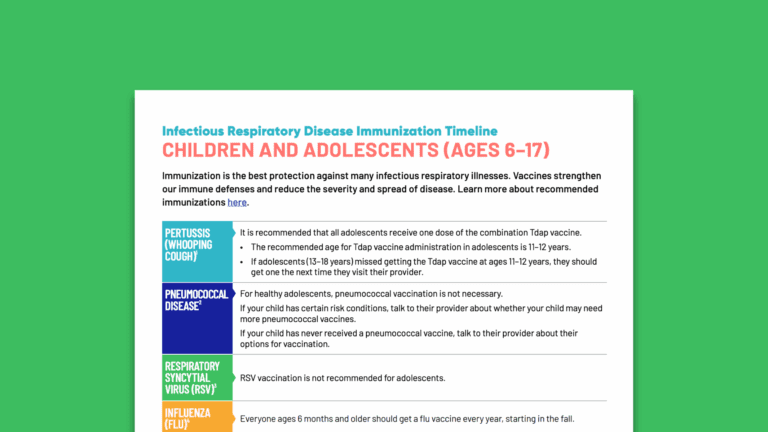
Vaccination is an important part of protecting a child’s health.
Not sure what your child may need? Talk with your child’s healthcare provider or use our Vaccine Locator Tool to find places that offer childhood vaccines near you. Pharmacy vaccine options for children can vary by state.