Treatments: Guidelines & Recommendations
Need vaccine information?
Check out the resources below.
Visit
Visit
Treatment options are available to help prevent severe illness from COVID-19 and influenza (flu).
While treatments are not a substitute, nor a replacement, for vaccines, there are several treatments approved by the Food and Drug Administration (FDA) for people at high risk of hospitalization or death from COVID-19 or flu.
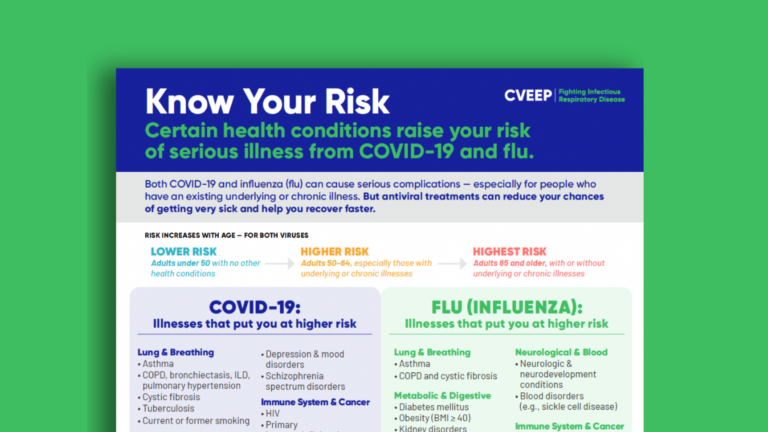
Many people don’t know they are at high risk of developing severe illness from COVID-19 or flu. If you are 50 and over, have diabetes, cancer, mental health conditions, obesity, asthma, or a number of other health conditions, you are at greater risk of developing severe illness from COVID-19 or flu.
What antiviral treatment options exist for COVID-19?
If you have mild to moderate COVID-19 symptoms, you may be eligible for treatment with an antiviral medication to help prevent more severe COVID-19 symptoms. These are prescription medicines and the decision to use them would be made with your healthcare provider.
- Oral antivirals: Pills that can be taken by mouth and can be obtained from a pharmacy with a prescription. Treatment must begin within 5 days after the first symptoms appear.
- Intravenous (IV) antivirals: An IV antiviral medicine must be administered at a hospital or other healthcare setting and treatment must start within 7 days after COVID-19 symptoms appear.
COVID-19 Treatments
| Name of Treatment | Type of Treatment | Who Can Receive It | When to Begin |
|---|---|---|---|
RECOMMENDED TO USE FIRST ACCORDING TO CDC |
|||
PAXLOVID(Nirmatrelvir/ritonavir) |
Pill form taken at home by mouth (orally) |
Adults; Children age 12 and older |
Start as soon as possible; must begin within 5 days of when symptoms start |
VEKLURY(Remdesivir) |
Intravenous (IV) infusions at a healthcare facility for 3 consecutive days |
Adults and children |
Start as soon as possible; must begin within 7 days of when symptoms start |
RECOMMENDED TO USE IF ABOVE MEDICATIONS CANNOT BE USED OR ARE UNAVAILABLE ACCORDING TO CDC |
|||
LAGEVRIO(Molnupiravir) |
Pill form taken at home by mouth (orally) |
Adults |
Start as soon as possible; must begin within 5 days of when symptoms start |
According to CDC, Paxlovid and Veklury (but not Lagevrio) are recommended for pregnant women.
What antiviral treatment options exist for influenza (flu)?
Flu antiviral treatments are also available, with a prescription from your healthcare provider, for individuals at higher risk of severe illness. These treatments help lessen the severity of symptoms and shorten the duration of illness. Treatments should be started quickly within 2 days after the first symptoms appear.
Flu Treatments
| Name of Treatment | Type of Treatment | Who Can Receive It | When to Begin |
|---|---|---|---|
TAMIFLU(Oseltamivir) |
Pill form taken at home by mouth (orally); a liquid form is also available |
All individuals at least 14 days old and older |
Start as soon as possible; must begin within 48 hours (2 days) of when symptoms start |
XOFLUZA(Baloxavir Marboxil) |
Single dose pill; taken at home by mouth (orally) |
All individuals age 12 and older; Children ages 5-12 without chronic conditions |
Start as soon as possible; must begin within 48 hours (2 days) of when symptoms start |
RELENZA(Zanamivir) |
Taken at home using an inhaler device, twice daily for 5 days |
All individuals age 7 and older |
Start as soon as possible; must begin within 48 hours (2 days) of when symptoms start |
RAPIVAB(Peramivir) |
Single intravenous (IV) infusion at a healthcare facility |
All individuals 6 months and older |
Start as soon as possible; must begin within 48 hours (2 days) of when symptoms start |
*According to CDC, Tamiflu is recommended during pregnancy. Xofluza is not recommended for women who are pregnant or breastfeeding, as there is no available data on its safety and efficacy in this group.
How effective are oral antivirals?
Oral antivirals are most effective when they are started as soon as possible after being infected — within 5 days after the first symptoms of COVID-19 begin and within 2 days after flu symptoms begin. Clinical trials have shown oral antivirals reduce the risk of hospitalization 60% for flu, and, according to CDC, antivirals reduce the risk of hospitalization due to COVID-19 by more than 50% and the risk of death due to the virus by 75%.
Do I need to test positive to be prescribed COVID-19 and flu oral antivirals?
No, a positive test is not required for a healthcare provider to prescribe antiviral medication for COVID-19 or flu. However, a prescription is required. If you know you’ve been exposed and are at higher risk for severe illness, talk to a healthcare provider about treatment as soon as possible.
How can I get oral antivirals?
Oral antivirals for COVID-19 and flu are available with a prescription from a healthcare provider, and in many cases, from a state-licensed pharmacist.
Cost and coverage options vary depending on the drug, and there are patient assistance programs, co-pay programs, and other plans to help ensure COVID-19 treatments will continue to be available at no or low cost for most individuals.
How are IV antivirals different from oral antivirals?
An IV antiviral is given as an intravenous (IV) infusion, which means treatment is delivered directly into the blood stream through a vein. Oral antivirals are taken by mouth in pill form. For COVID-19, IV antiviral treatment occurs in a hospital or other healthcare setting, once a day for three days and should begin within 7 days after symptoms begin. For flu, there is a single-dose IV treatment available, given in a healthcare setting, and should begin within 2 days after the first symptoms begin. Talk to a healthcare provider to determine the best treatment option for you.
Do COVID-19 antivirals cause rebound?
Rebound – the return of mild COVID-19 symptoms – can happen whether you use antiviral treatments or not. According to CDC, rebound has been reported in people both with and without the use of COVID-19 antivirals. COVID-19 antiviral treatments can help prevent severe illness, hospitalization, and death, which means the benefits are much greater than the risks of rebound.
What treatment options are available for other infectious respiratory diseases?
All treatments should be discussed with your healthcare provider and may require a prescription.
Respiratory Syncytial Virus (RSV)
- Antivirals: In some severe cases, antiviral medications like ribavirin may be used.
- Supportive Care: This includes hydration, oxygen therapy, and suctioning of nasal secretions to relieve symptoms.
Pneumococcal Disease
- Antibiotics: Treatment typically involves antibiotics such as penicillin, amoxicillin, or erythromycin to combat bacterial infection.
- Supportive Care: This includes pain management and fluids to help with recovery.
Pertussis (Whooping Cough)
- Antibiotics: Early treatment with antibiotics such as azithromycin, clarithromycin, or erythromycin can reduce the severity and spread of the infection.
- Supportive Care: This involves rest, fluids, and keeping the individual comfortable while recovering.